For centuries, multiplication was difficult and dangerous. Sailors navigating by stars had to multiply 10-digit numbers by hand; one mistake meant crashing into rocks. Then, in 1614, John Napier invented Logarithms, turning impossible multiplication into simple addition. They saved thousands of lives.
Today, logs aren't just for calculation. They are the language of perception. Humans perceive the world logarithmically, not linearly.
1. What is a Logarithm?
It is simply an exponent in reverse. It asks: "What power must the base be raised to, to get this number?"
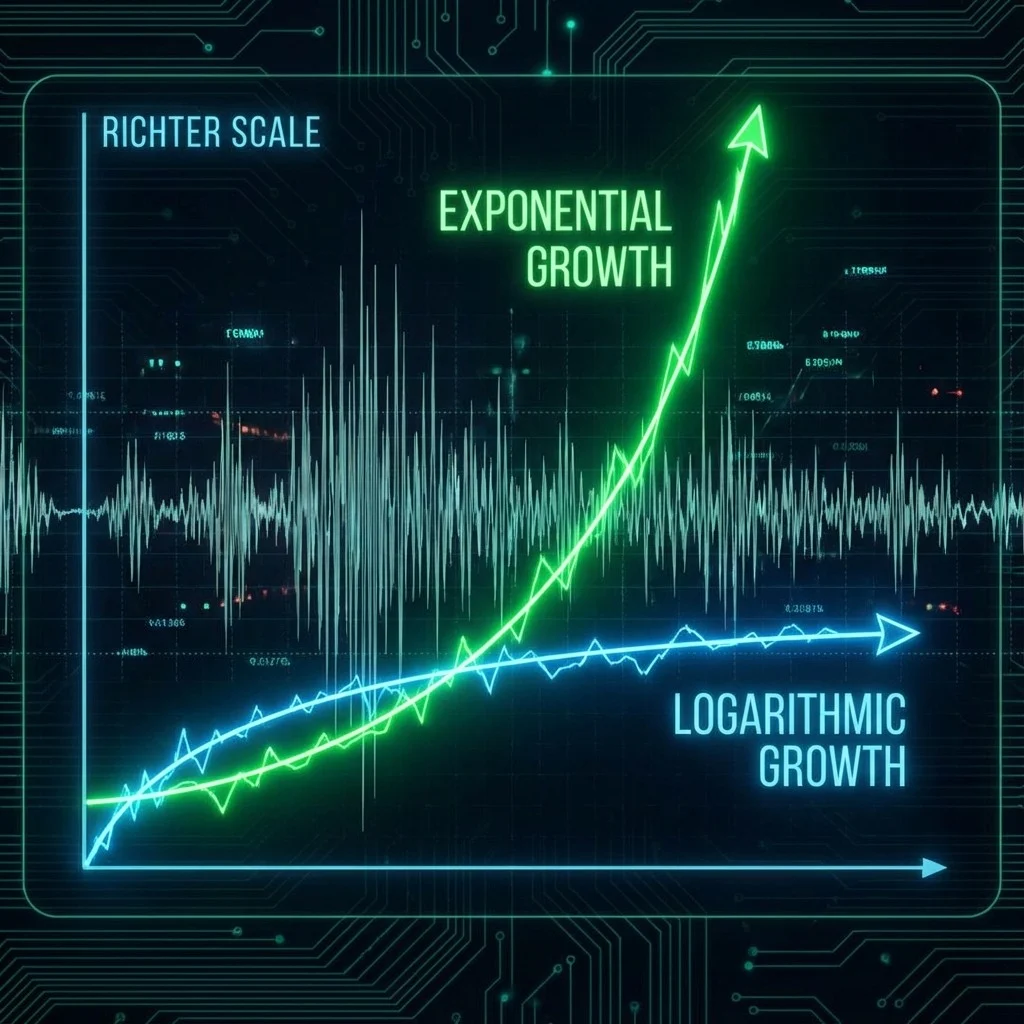
• Linear Growth: 1, 2, 3, 4, 5 (Stairs)
• Exponential Growth: 2, 4, 8, 16, 32 (Viral)
• Logarithmic Growth: The inverse. It starts fast and levels off.
2. The Richter Scale (Earthquakes)
A magnitude 5 earthquake shakes your windows. A magnitude 6 shakes your walls. A magnitude 7 destroys your house.
They sound close (5, 6, 7), but the Logarithmic Scale hides the truth.
Each step is a 10x increase in amplitude and approx 31x increase in energy.
• Magnitude 6 is 10x stronger than 5.
• Magnitude 7 is 10x10 = 100x stronger than 5.
• Magnitude 9 (Japan 2011) is 10,000x stronger than a magnitude 5. Even a small diff in log number means massive real-world impact.
3. Decibels (How We Hear)
If you play a sound at speaker volume 1, and then volume 2, it sounds "twice as loud". But in reality, the pressure wave is 10 times stronger. Our ears define "loudness" based on ratios, not addition.
We use the Decibel (dB) scale:L = 10 * log(I / I₀)
• Whisper: 20 dB
• Conversation: 60 dB
• Jet Engine: 140 dB
Because it's a log scale, 140dB isn't "a bit louder" than 60dB. It is billions of times more powerful.
4. The pH Scale (Acidity)
In Chemistry, pH measures the concentration of Hydrogen ions (H+). pH = -log[H+]
• Water (pH 7) is Neutral.
• Lemon Juice (pH 2) is Acidic.
Because of the log scale, pH 2 has 100,000 times more hydrogen ions than pH 7. This is why a small change in blood pH can kill you instantly.
5. The Natural Log (ln) and 'e'
The number e (2.718...) is the speed limit of growth. It represents 100% continuous compounding.
The Natural Log (ln) tells you how much time is needed to reach a certain level of growth.
• If you want to double your money (2x) at 100% interest, how long does it take? ln(2) = 0.693 units of time.
6. FAQ
Q: Why can't I take the log of a negative number?
A: Because you cannot multiply a positive base (like 10 or e) by itself any number of times to get a negative result. 10^x is always positive.
Q: What is the difference between Log and Ln?
A: "Log" usually implies Base 10 (Engineering). "Ln" implies Base e (Nature/Calculus). They work the same way, just different scales.
Conclusion
Logarithms are the lens through which we view vast ranges of data. They turn giants (millions/billions) into manageable numbers (6, 7, 8). Understanding logs allows you to understand the scale of the universe, from the subatomic (pH) to the galactic (light years).