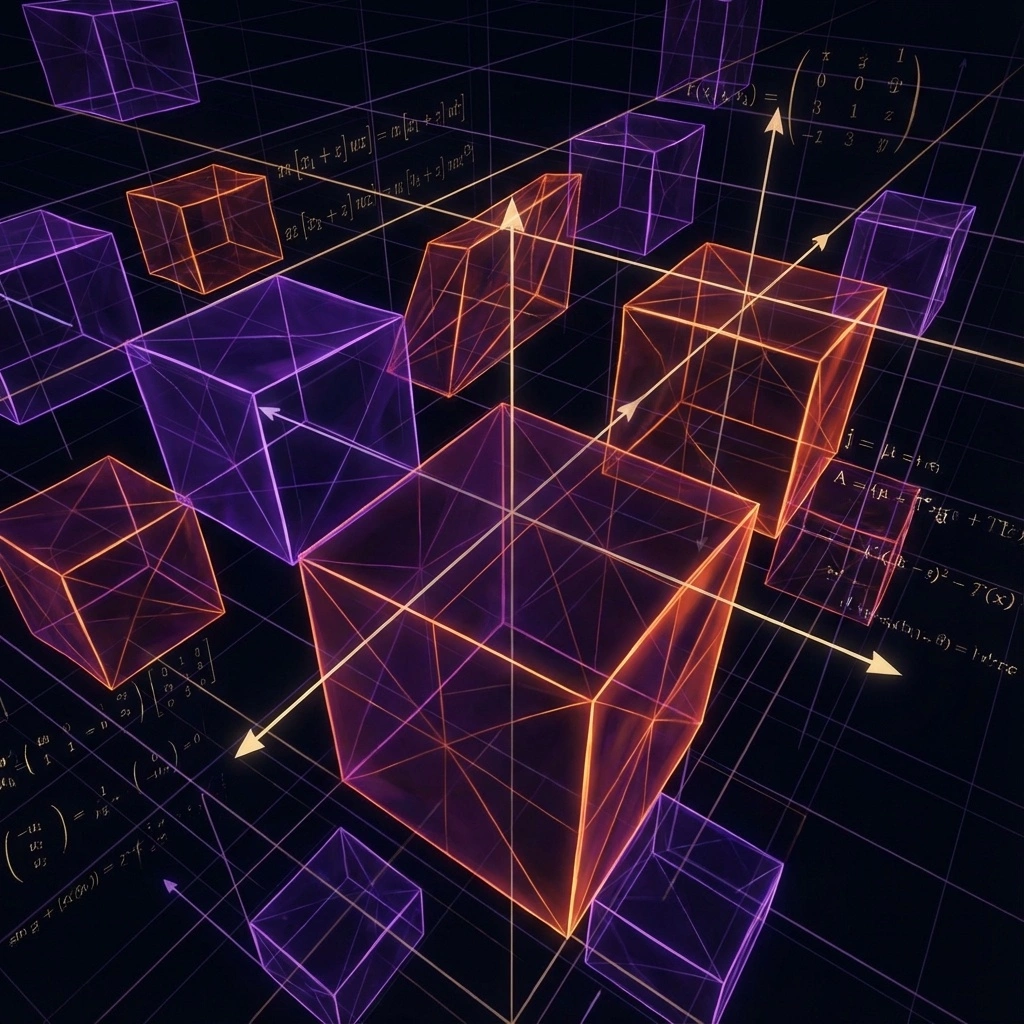
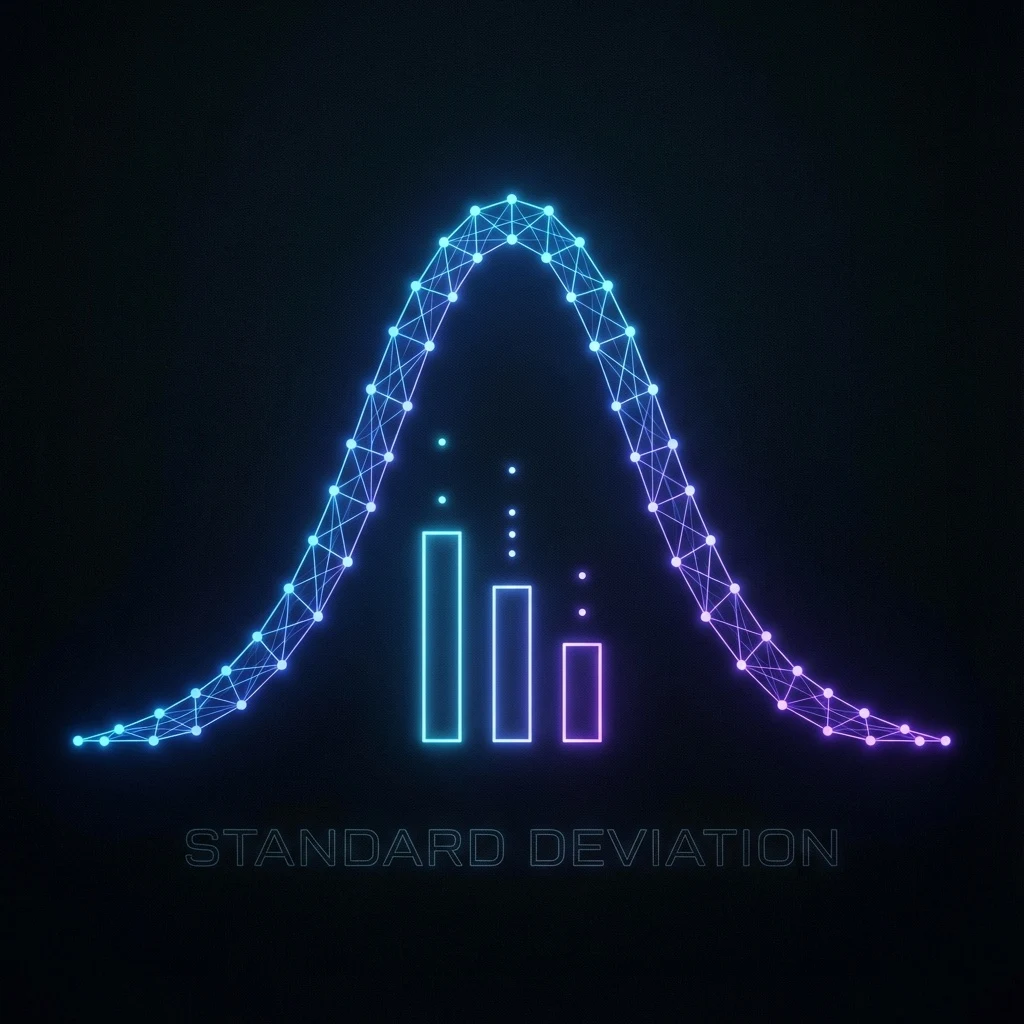
A function like f(x) = x³ - 2x + 1 is just a string of symbols. It tells you nothing about the behavior of the system. But the moment you plot it on a graph, the story emerges. You see the peaks, the valleys, and the rate of change.
We are visual creatures. 40% of the human brain is dedicated to visual processing. Graphing turns abstract algebra into concrete shapes that we can understand instantly.
1. The Cartesian Coordinate System
René Descartes, a French philosopher, looked at a fly on his ceiling and realized he could describe its location with two numbers: distance from the bottom wall (x) and distance from the side wall (y).
This invention bridged Algebra (Equations) and Geometry (Shapes). It is why we can solve geometry problems using algebra.
2. The Four Fundamental Families
Almost everything in nature fits into one of these 4 shapes:
A. Linear (y = mx + b)
A straight line. Constant slope.
Real World: If you get paid $15/hour, your income graph is a line.
B. Quadratic (y = ax² + bx + c)
A U-shape (Parabola). Symmetrical.
Real World: Throwing a ball. The path to the top is the mirror image of the path down.
C. Exponential (y = a · b^x)
The "Hockey Stick". Starts slow, then explodes.
Real World: Bacteria growth, Compound interest, Viral videos.
D. Periodic (y = sin(x))
A wave. It repeats forever.
Real World: Music, Heartbeats, Tides, Alternating Current (AC) electricity.
3. Reading the "Fingerprints" of a Graph
When analyzing business data or scientific results, look for these features:
- X-Intercepts (Roots): Where y=0. In business, this is the "Break-Even Point". Before this point, you lose money; after it, you make money.
- Y-Intercept: Where x=0. This is the "Initial Condition". The starting temperature, the starting cash, etc.
- Slope: The rate of change. Steep slope = Fast change. Flat slope = Stagnation.
- Extrema (Max/Min): The highest or lowest point. The sweet spot for profit optimization.
4. Asymptotes: The Unreachable Lines
Some graphs have invisible fences they recall "Asymptotes".
Example: 1/x. As x gets closer to 0, 1/x goes to infinity. The graph shoots up the wall but never touches it.
In physics, the Speed of Light (c) is a vertical asymptote. You can get closer and closer, but you need infinite energy to reach it.
5. Why Graphing Calculators Matter
Before computers, finding the root of x^5 - 3x + 1 = 0 was nearly impossible. You had to guess numbers for hours.
Now, you graph it and look at where it crosses the line. Seeing the shape prevents "silly errors"—if your calculation says the rocket is going down but the graph says it's going up, you know you missed a minus sign.
Conclusion
Graphing is not just drawing lines. It is data storytelling. It allows us to compress millions of data points into a single curve that a human can understand in one second.