We live in the Information Age, but data without context is just noise. Statistics is the art of translating raw numbers into meaningful stories. It helps us answer questions like "Is this drug safe?", "Who will win the election?", and "Is global warming real?" It is the immune system of the mind, protecting you from deception.
1. The Measure of Center (Averages)
When someone says "The average American makes $60k", what do they mean? There are 3 different "averages", and they tell different stories.
- Mean (The Equalizer): Add up everything and divide by the count. This is what we usually mean by "Average". Weakness: It is easily destroyed by outliers. (If Jeff Bezos walks into a homeless shelter, the "Mean" net worth of everyone inside becomes $1 Billion. This is mathematically true but descriptively false).
- Median (The Middle Man): Line everyone up from poorest to richest. Pick the guy in the middle. This is Robust. In the Jeff Bezos example, the Median net worth stays at $0. This is why home prices and salaries are always reported as Median.
- Mode (The Trend): The most common number. Useful for non-numerical data (e.g., "The average car color is Silver").
2. The Measure of Spread (Variance)
Two classes can have the same average score (75%), but be totally different.
• Class A: Everyone got a 75. (Spread = 0).
• Class B: Half got 50, Half got 100. (Spread = Huge).
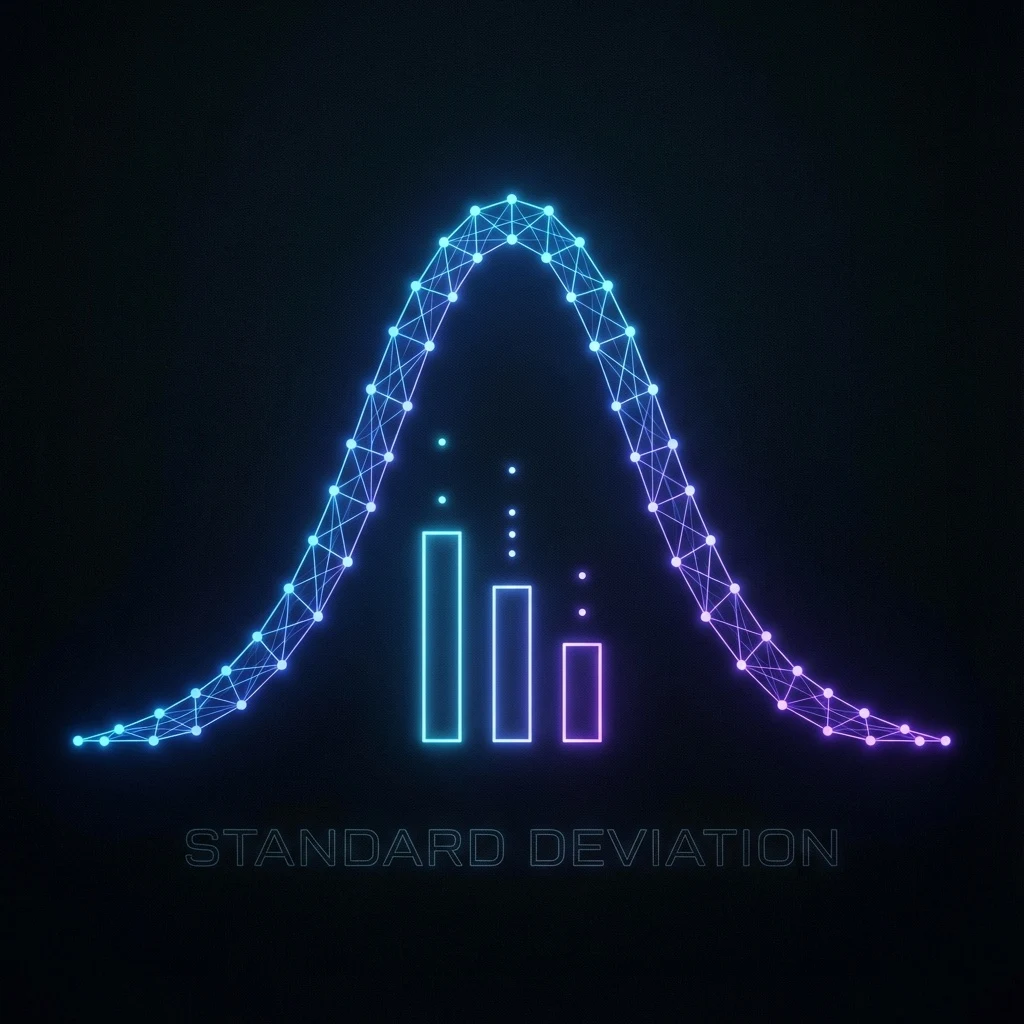
Standard Deviation (σ): This measures how far, on average, a data point is from the Mean.
Think of temperature: A room at 70°F is comfortable. A room that alternates between 140°F (Oven) and 0°F (Freezer) also has an average of 70°F, but it will kill you. The average is the same, but the variance is deadly.
3. Sampling and Bias
How do you know who will win the election without asking all 300 million Americans? You ask a sample of 1,000.
BUT, the sample must be random.
Selection Bias (The 1936 Fail):
In 1936, a magazine polled 2 million people via telephone and predicted Alf Landon would crush FDR. FDR won in a landslide. Why? In the Great Depression, only rich people had phones. They polled rich Republicans and ignored poor Democrats.
Survivorship Bias (The WWII Planes):
The military looked at returning planes and saw bullet holes in the wings. They decided to armor the wings. Mathematician Abraham Wald stopped them: "The planes with holes in the cockpit didn't come back." You must armor the empty spots.
4. Correlation vs Causation
The Golden Rule of Statistics: Correlation does NOT equal Causation.
Spurious Correlations:
Did you know that the number of people who drowned in pools correlates 99% with the number of films Nic Cage appeared in that year?
Does Nic Cage cause drownings? No. This is random noise masquerading as a pattern.
Often, there is a hidden 3rd variable (Confounding Variable). Ice cream sales correlate with murder rates. The hidden variable is Heat.
5. Hypothesis Testing & P-Values
In science, we assume nothing is happening (Null Hypothesis). We only change our minds if the data makes the Null look ridiculous.
The P-Value:
It measures the probability that your results happened by luck.
• P < 0.05: There is less than a 5% chance this is luck. Result is "Significant."
• P > 0.05: It could just be noise. Discard it.
Type I vs Type II Errors:
• Type I (False Positive): Convicting an innocent man. (You thought there was a pattern, but there wasn't).
• Type II (False Negative): Letting a guilty man go free. (You missed the pattern).
6. Simpson's Paradox
This is where stats get scary. A trend can appear in different groups of data but disappear or reverse when these groups are combined.
The UC Berkeley Case (1973):
Data showed that 44% of men were admitted to grad school, but only 35% of women. It looked like huge bias against women.
But when they looked at individual departments, women actually had higher acceptance rates than men in almost every department!
The Cause: Women were applying to the hardest departments (low acceptance rates for everyone), while men applied to easier departments. The aggregate data lied.
7. The Confidence Interval
You often hear "Biden is leading by 4 points, margin of error +/- 3%."
This doesn't mean the poll is wrong. It means "We are 95% confident that the true number is between 1% and 7%."
Statistics never deals in absolutes. It deals in ranges of confidence.
8. FAQ
Q: Can statistics prove anything?
A: No. Statistics can only provide evidence to support a hypothesis. It cannot prove truth with 100% certainty.
Q: What is Regression toward the Mean?
A: If you have an amazing day today, you will likely have a worse day tomorrow. Not because you are cursed, but because "Amazing" is rare, and "Average" is common.
Conclusion
Statistics is a defensive martial art. It protects you from being lied to by politicians, marketers, and news outlets who use true numbers to tell false stories. Question the sample. Check the variance. Look for the lurking variable.