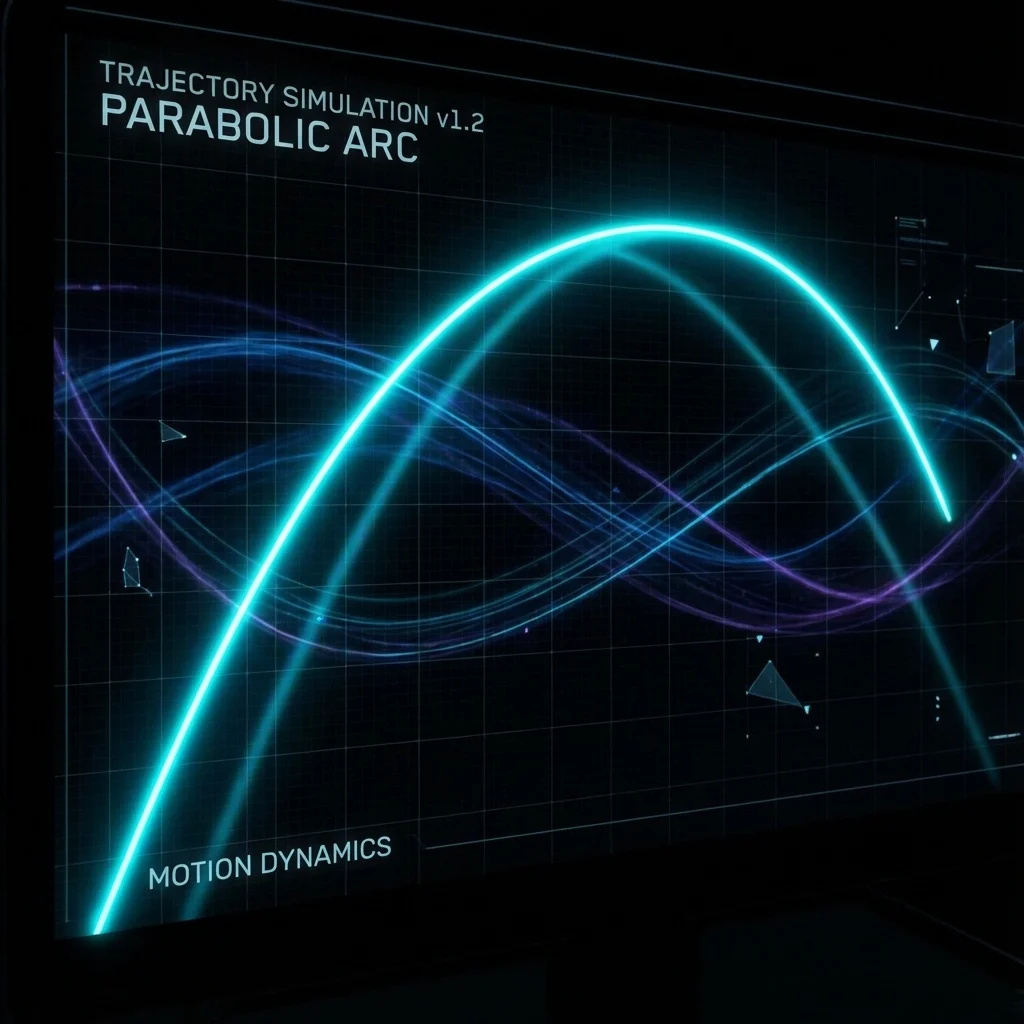
If you throw a ball, fire a cannon, or drive a car off a cliff (in a movie), they all follow the exact same path. It isn't a circle, and it isn't a straight line. It is a Parabola.
Projectile motion is the perfect marriage of Algebra and Physics. It shows how two simple rules (Inertia and Gravity) combine to create complex curved motion.
1. The Two Independent Motions
The secret to understanding projectile motion is to realize that Horizontal and Vertical motion are completely separate. They don't know the other exists.
- Horizontal (X-axis): There is no gravity sideways. If we ignore air resistance, the object keeps moving at the same speed forever. (a_x = 0).
- Vertical (Y-axis): Gravity is pulling down constantly. The object starts fast, slows to a stop at the peak, and accelerates downwards. (a_y = -9.8 m/s²).
2. The Equations (Kinematics)
We use the standard kinematic equations, split into x and y.
x(t) = v₀·cos(θ)·t
y(t) = v₀·sin(θ)·t - 0.5·g·t²
Notice the t² in the Y equation. That quadratic term is what makes the shape a Parabola.
3. The Launch Angle Debate
If you want to throw a ball as far as possible, what angle should you use?
45 Degrees.
- Angle > 45: You get lots of height (Hang Time), but no horizontal speed. The ball goes up and down.
- Angle < 45: You get lots of speed, but no air time. The ball hits the ground too early.
- Angle = 45: The perfect balance of air time and horizontal velocity.
Fun Fact: This assumes no air resistance. In the real world (with air drag), the optimal angle is actually slightly lower, around 37-40 degrees.
4. Hitting a Target (The Monkey Problem)
A classic physics problem: A hunter aims a gun directly at a monkey hanging from a tree. The moment he shoots, the monkey drops. Does the bullet hit the monkey?
Answer: YES.
Why? Because gravity affects the bullet and the monkey exactly the same. They both "fall" below the straight-line path by 0.5·g·t². Since they fall the same amount, they collide. Physics works!
5. Real World Applications
- Sports: Basketball players implicitly calculate parabolas every time they shoot. A higher arc (higher entry angle) gives a larger "target" area for the hoop.
- Military: Artillery and ballistics are pure projectile motion. Snipers must adjust for "bullet drop" over long distances.
- CGI/VFX: To make an explosion look real in a movie, debris must follow parabolic paths. If it flies in a straight line, the audience knows it's fake.
6. FAQ
Q: Does mass affect trajectory?
A: In a vacuum? No. A feather and a bowling ball follow the exact same parabola. In air? Yes, because lighter objects are affected more by air resistance.
Q: What is Terminal Velocity?
A: When air resistance pushes up as hard as gravity pulls down, you stop accelerating. A human skydiver tops out at around 120 mph.
Conclusion
Projectile motion turns the invisible force of gravity into a visible shape. It is one of the most beautiful and predictable patterns in nature, governing everything from a flowing fountain to a home run.