Calculus is arguably the most important mathematical discovery in human history. Before Calculus (specifically before Newton and Leibniz in the 1600s), math could only describe static things: a circle, a square, a constant speed. But the real world moves. Planets orbit, stocks crash, and viruses spread.
To describe dynamic change, we need the Derivative. In this guide, we will move past the confusing limit definitions and get to the core practical skills you need to ace Calculus I.
1. What IS a Derivative?
Forget the equations for a second. Think about driving a car.
- Function f(t): Your position (Distance from home).
- Derivative f'(t): Your speed (How fast position is changing).
- Second Derivative f''(t): Your acceleration (How fast speed is changing).
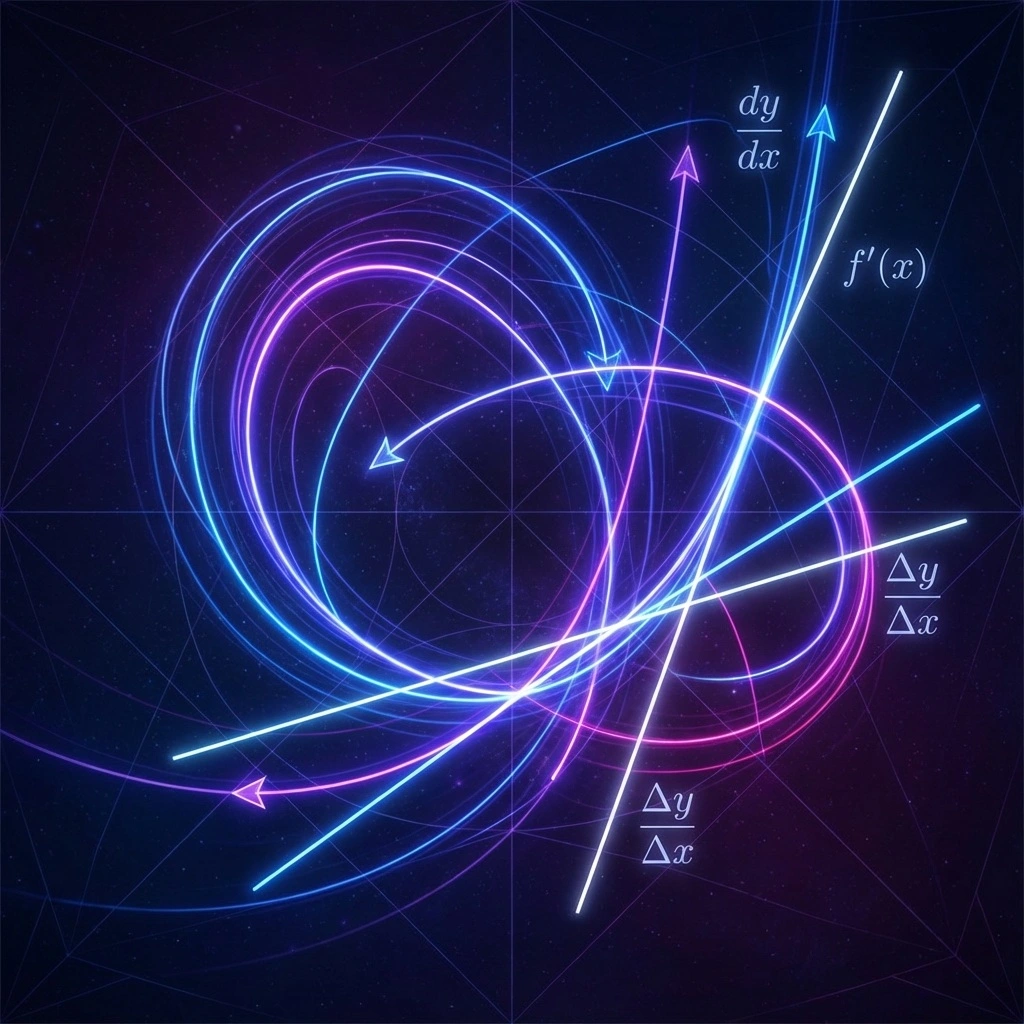
Mathematically, the derivative is the Slope of the Tangent Line at a specific point. If you have a curve, and you zoom in infinitely close to one point, the curve looks like a straight line. The slope of that line is the derivative.
2. The Power Rule (The 90% Rule)
If you learn nothing else, learn this. It solves polynomial derivatives instantly.
Step-by-Step Examples:
1. f(x) = x⁵
Bring the 5 down. Subtract 1 from 5.
Result: 5x⁴
2. f(x) = 3x²
Bring the 2 down and multiply by 3 (2*3=6). Subtract 1 from 2.
Result: 6x¹ or just 6x
3. f(x) = 7x + 10
Derivative of 7x is just 7. Derivative of a constant (10) is 0 because constants don't change.
Result: 7
3. The Product and Quotient Rules
What if two functions are multiplied? You can't just take the derivative of each. You need the product rule.
Product Rule: (Left · Right)' = Left'·Right + Left·Right'
"Derivative of first times second, plus first times derivative of second."
Quotient Rule: (High / Low)' = (Low·High' - High·Low') / Low²
"Low D-High minus High D-Low, over the square of what's below." This rhyme has saved millions of students.
4. The Chain Rule (The Onion)
This is where students fail. The Chain Rule applies when a function is inside another function, like sin(x²).
Method:
1. Differentiate the Outside layer (leave inside alone).
2. Multiply by the Derivative of the Inside layer.
Example: y = (3x + 1)¹⁰
• Outside: Power rule. Bring 10 down. -> 10(3x + 1)⁹
• Inside: Derivative of 3x + 1 is 3.
• Result: 10(3x + 1)⁹ * 3 = 30(3x + 1)⁹
5. Higher Order Derivatives
You can take the derivative... of a derivative.
• f(x) = Position
• f'(x) = Velocity
• f''(x) = Acceleration
• f'''(x) = Jerk (Yes, that's the real physics term!)
Engineers care deeply about "Jerk" when designing elevators and roller coasters. You want speed and acceleration, but you don't want sudden changes in acceleration (Jerk), or people get whiplash.
6. Optimization: The "Money" Application
The most lucrative application of derivatives is finding Maxima and Minima.
Imagine a profit curve for a business. It goes up, peaks, and comes down. At the very peak, the slope is exactly zero (horizontal).
To maximize profit:
1. Find the Profit Equation P(x).
2. Find P'(x).
3. Set P'(x) = 0 and solve for x.
7. FAQ
Q: Why is the derivative of e^x just e^x?
A: e (2.718...) is the unique number where the slope of the curve is equal to the value of the curve at every point. It represents perfect continuous growth.
Q: What is a partial derivative?
A: If you have variables x and y, a partial derivative asks "How does the function change if I only move x, keeping y frozen?" It's used in 3D calculus.
Conclusion
Derivatives are the microscope of mathematics. They allow us to freeze time and analyze the instant rate of change of anything in the universe. Once you understand the pattern, you see them everywhere.