In Calculus, you will often encounter integrals that look impossible to solve, like ∫ sin²(x) dx. If you try to integrate it directly, you will fail. But if you know your identities, you can swap it for an easier version in seconds.
Trigonometric Identities are essentially "equations that are always true". They allow you to rewrite math problems into different formats. Here are the top 10 you need for success.
1. The Pythagorean Identities
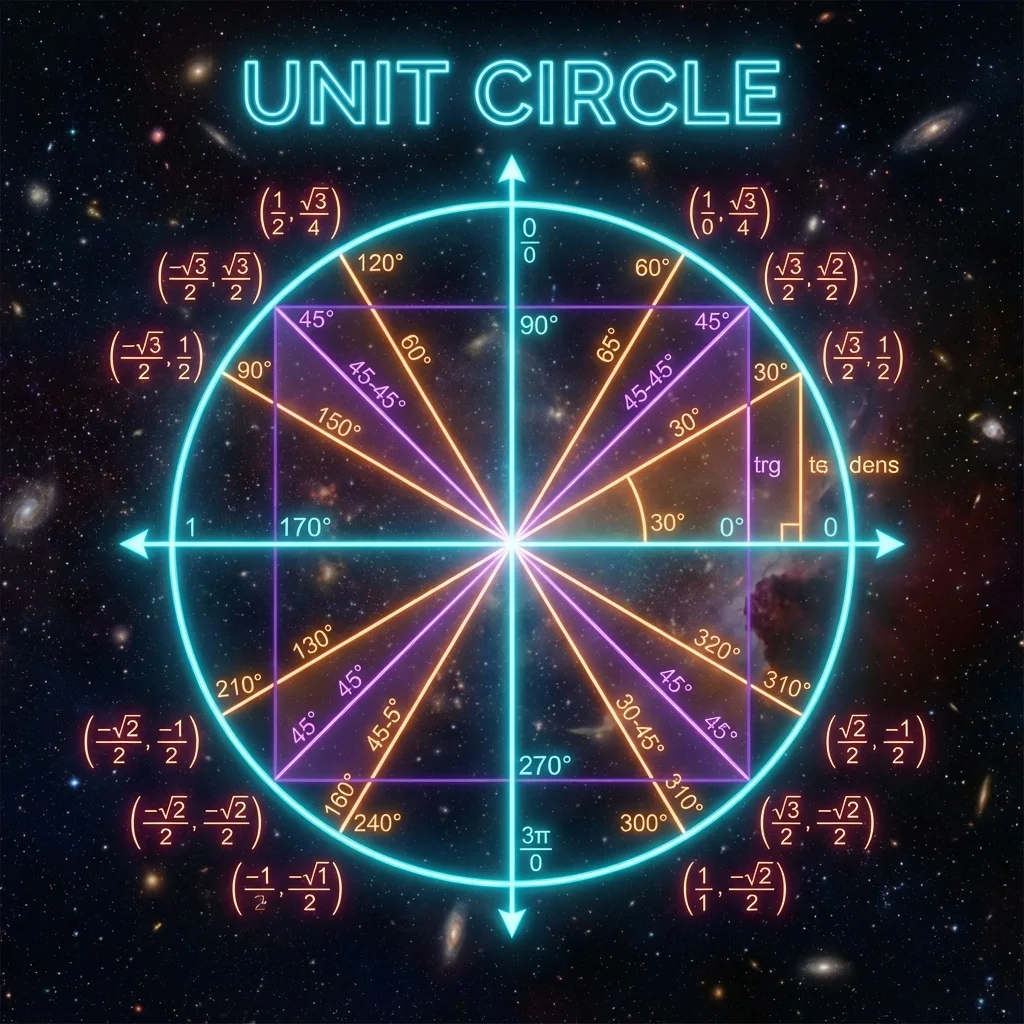
This is the grandfather of all identities. It comes directly from the Unit Circle triangle (x² + y² = 1).
Variations (Divide by cos²):
tan²θ + 1 = sec²θ
Variations (Divide by sin²):
1 + cot²θ = csc²θ
2. Quotient and Reciprocal Identities
These are the definitions. Never forget them.
- Tan(θ) = Sin(θ) / Cos(θ)
- Cot(θ) = 1 / Tan(θ) = Cos(θ) / Sin(θ)
- Sec(θ) = 1 / Cos(θ) (Secants pair with Cosines)
- Csc(θ) = 1 / Sin(θ) (Co-secants pair with Sines)
3. Double Angle Formulas
These are crucial for simplifying expressions where the angle is doubled.
Sine:
sin(2x) = 2sin(x)cos(x)
Cosine (3 flavors):
1. cos(2x) = cos²x - sin²x
2. cos(2x) = 2cos²x - 1
3. cos(2x) = 1 - 2sin²x
Pro Tip: In Calculus integration, use versions 2 or 3 to convert squares into linear terms (Power Reduction).
4. Sum and Difference Formulas
How do you find exact values for non-standard angles like 15° or 75°? You break them into standard angles (45° - 30°).
- sin(A ± B) = sinA cosB ± cosA sinB
- cos(A ± B) = cosA cosB ∓ sinA sinB (Note the sign flip!)
- tan(A ± B) = (tanA ± tanB) / (1 ∓ tanA tanB)
5. Odd and Even Identities
Symmetry tells us how functions behave with negative inputs.
- Even (Symmetric Y-axis): Cos(-x) = Cos(x). (It "eats" the negative sign).
- Odd (Symmetric Origin): Sin(-x) = -Sin(x). (It "spits out" the negative sign).
6. Real World Application: Signal Processing
Your Wi-Fi signal is a complex waveform. Engineers use Fourier Transforms to break this complex wave into a sum of simple Sines and Cosines. This relies entirely on the Sum-to-Product identities to separate noise from data.
7. FAQ
Q: Do I really need to memorize all of these?
A: You MUST memorize Pythagorean, Double Angle, and Quotient identities. The Sum/Difference ones are usually provided on formula sheets, but knowing them speeds you up.
Q: How do I prove an identity?
A: Start with the "complex side" and try to simplify it to match the "simple side". Convert everything to Sin and Cos first.
Conclusion
Identities are the tools in your toolbox. You can't build a house with just a hammer (Sin/Cos). Sometimes you need a screwdriver (Tan/Sec). Memorize these top 10, and Calculus will become significantly easier.